What Are Clear Aligners?
Clear aligners are transparent, custom-designed trays that apply controlled pressure to gradually reposition teeth into proper alignment. Unlike conventional braces, aligners do not rely on visible brackets or metal wires.
Clear aligners have transformed modern orthodontics by offering nearly invisible, removable trays designed to gradually move teeth — giving patients a more discreet and lifestyle-friendly path to a straighter smile.
Each set of aligner trays is worn for a prescribed duration and replaced progressively as treatment advances. At Pal Dental Clinic, clear aligner treatment is integrated with digital diagnostics and personalised orthodontic planning to deliver modern smile correction solutions in Calicut (Kozhikode).
How the Clear Aligner Process Works
Modern aligner workflows move well beyond simple tray fitting. A comprehensive, digitally guided process ensures teeth move predictably, comfortably, and in the right sequence throughout treatment.
Digital Planning Workflow
- Digital smile assessment
- Intraoral scanning
- Customised treatment mapping
- Sequential aligner fabrication
- Progress monitoring reviews
- Retention planning after completion
Patient Experience
- Nearly invisible appearance
- Removable during meals
- No metal brackets or wires
- Easier oral hygiene routine
- Regular clinical reviews
- Retainer support after treatment
Why Clear Aligners Are Becoming Popular in Calicut
Patients increasingly search for orthodontic treatments that fit professional, social, and lifestyle expectations. Community discussions frequently highlight aesthetics, convenience, and reduced food restrictions as major reasons people choose aligners over traditional braces.
1. Nearly Invisible Appearance
Clear trays make orthodontic treatment far less noticeable than metal braces. For working professionals, students, and those concerned about aesthetics, this is often the primary motivation for choosing aligners.
2. Removable Convenience
Aligners can typically be removed during meals and oral hygiene routines, which means fewer restrictions on diet and significantly easier brushing and flossing throughout treatment.
3. Digital Treatment Planning
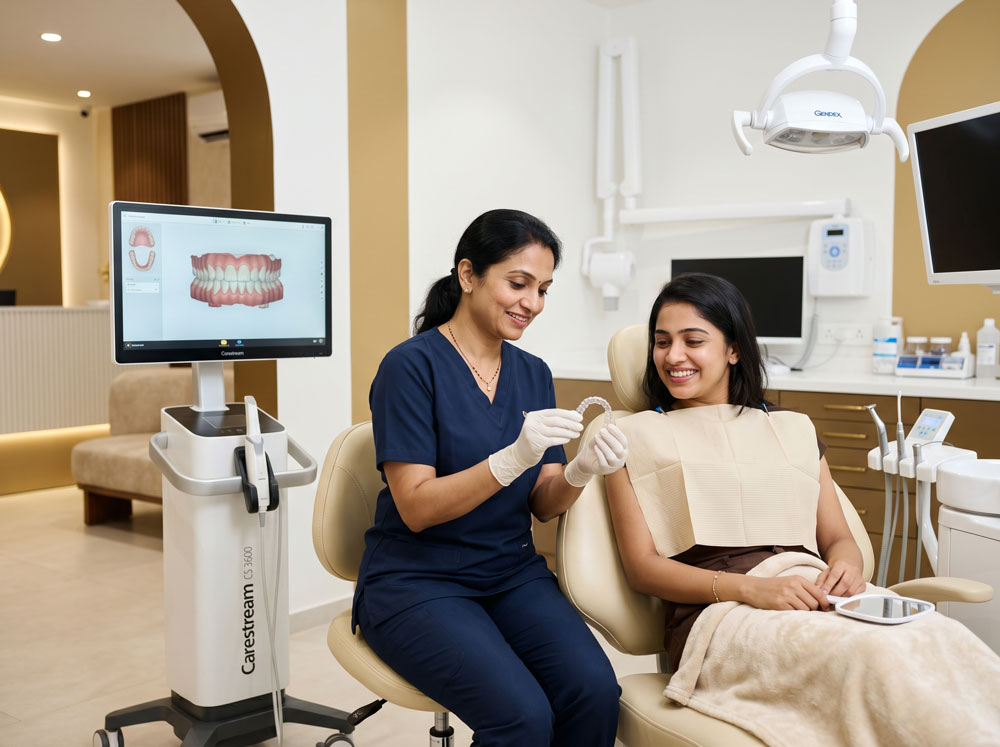
Modern aligner workflows use 3D intraoral scans and digital simulations instead of conventional impressions. Pal Dental Clinic highlights intraoral scanning for precision-based treatment planning and improved patient comfort — removing the discomfort of traditional putty impressions entirely.
4. Improved Day-to-Day Comfort
Without metal brackets and wires, patients generally find aligners more comfortable for day-to-day wear. There are no sharp edges to irritate cheek or gum tissue, which is a common concern with conventional braces.
5. Flexible Lifestyle Integration
Because aligners are removable, patients can attend social occasions, professional meetings, or sporting activities without the aesthetic or physical concerns that metal braces can sometimes create.
At Pal Dental Clinic, aligner treatment is described as customised and designed to improve comfort while supporting effective, predictable alignment outcomes for each individual patient.
Who Is a Good Candidate for Clear Aligners?
Clear aligners may be considered for a range of selected orthodontic concerns. A clinical evaluation is essential because not every case is ideal for aligners alone — treatment planning depends on tooth position, jaw relationships, and long-term bite stability.
Mild to Moderate Crowding
Teeth that are slightly overlapping or overcrowded can often be addressed effectively with a planned sequence of aligner trays.
Gaps Between Teeth
Spaces or diastemas between teeth can be gradually closed through controlled aligner-directed tooth movement.
Mild Bite Irregularities
Selected bite concerns such as mild overbites or crossbites may be amenable to aligner-based correction depending on clinical assessment.
Rotated Teeth
Minor rotations of individual teeth can be addressed within a staged aligner treatment plan with appropriate clinical management.
Adult Orthodontic Correction
Adult patients who did not receive orthodontic treatment earlier — or who have experienced minor relapse — find clear aligners a practical and discreet solution.
Cosmetic Alignment Improvements
Patients seeking aesthetic smile improvements rather than complex bite correction are often excellent candidates for aligner-based treatment.
The Clear Aligner Treatment Process at Pal Dental Clinic
Each stage of aligner treatment is planned with care to ensure that tooth movement progresses comfortably and predictably from start to finish.
Step 1: Consultation and Smile Analysis
The dentist evaluates facial balance, bite relationship, and alignment goals during the initial consultation. This assessment determines whether clear aligners are the most appropriate treatment pathway for the individual patient.
Step 2: Digital Intraoral Scanning
Three-dimensional intraoral scans replace traditional impressions, providing more accurate data for treatment planning and significantly improving patient comfort during the diagnostic phase.
Step 3: Customised Treatment Mapping
A personalised sequence of aligners is designed based on the digital scan data. Patients can often visualise a simulation of expected tooth movement before treatment begins, aiding in informed decision-making.
Step 4: Aligner Delivery and Wear Instructions
Patients receive staged aligners along with detailed wear and care instructions. Each set of trays is replaced at prescribed intervals as teeth progressively move toward their target positions.
Step 5: Progress Monitoring
Regular clinical reviews ensure teeth movement remains predictable and on schedule. Adjustments can be made to the treatment plan if needed based on how teeth are responding.
Step 6: Retention Phase
After active alignment is complete, retainers are provided to help preserve treatment outcomes and prevent teeth from drifting back toward their original positions over time.
Clear Aligners vs Traditional Braces
Both clear aligners and traditional braces are effective orthodontic treatments. Treatment suitability should always be determined clinically rather than on appearance preferences alone. The following overview helps patients understand the general differences.
| Factor | Clear Aligners | Traditional Braces |
|---|---|---|
| Visibility | Nearly invisible | Visible |
| Removability | Yes — during meals & hygiene | No — fixed throughout |
| Eating Restrictions | Minimal | More restrictions apply |
| Oral Hygiene | Easier maintenance | More maintenance required |
| Lifestyle Flexibility | Higher | Moderate |
| Complex Cases | Selected cases only | Wider case suitability |
Technology Behind Modern Clear Aligners
Advanced orthodontic aligner treatment increasingly combines cutting-edge digital tools to improve accuracy, comfort, and predictability of outcomes.
Modern aligner workflows commonly integrate digital smile simulation to allow patients to preview expected outcomes, 3D intraoral scanning for precise digital impressions, AI-assisted planning to map optimal tooth movement sequences, customised staging to ensure teeth move safely and efficiently, and precision tracking at each clinical review to verify progress and refine plans as needed.
Emerging research continues to improve digital aligner planning and simulation accuracy, making aligner treatment increasingly reliable across a wider range of clinical presentations.
Why Digitally Planned Orthodontic Care Matters
Successful aligner outcomes depend on significantly more than simply providing transparent trays. The quality of diagnosis, scanning accuracy, monitoring frequency, and long-term retention planning all contribute to durable, satisfying results.
Pal Dental Clinic highlights its commitment to orthodontic care, intraoral scanning capability, cosmetic smile solutions, and access to certified aligner expertise within its clinical team — ensuring that patients in Calicut (Kozhikode) receive both the technology and the clinical skill needed for successful treatment.